 CartVisual
Packaging studio / PUBLISHING WORKFLOW
Can I reuse the same box artwork when I switch packaging suppliers?
Equal assembled box dimensions do not establish that two suppliers use the same flat structure. Confirm the receiving template and artwork revision as a pair.
Identify the drawing behind the artwork
A fictional seller, Cedar Cup, moves a carton order from Supplier A to Supplier B. Both quotes describe a similarly sized box, so the seller is tempted to resend last season’s artwork. First ask B for the current production drawing, its identifier and revision, the intended stock and the measurement convention. Ask whether the existing drawing can actually be used for this order.
Pacdora’s dieline workflow treats structure, dimensions, material and thickness as inputs. That supports asking about more than outside size. The supplier-revision record proposed here is our editorial handoff method, not a claim that Pacdora or CartVisual approves your new manufacturer’s tooling.
Map changes before placing the artwork
Have the production designer compare A’s old drawing with B’s confirmed template at the correct units and scale. Identify print faces, folds, cuts, closure and glue areas using the receiving supplier’s definitions. A matching front panel does not establish that the back, side or closure has stayed identical. Keep template marks distinct from artwork.
| Record | Why it matters |
|---|---|
| Supplier and drawing identifier | Names the structure actually being ordered |
| Structural revision | Distinguishes old and current geometry |
| Artwork revision | Identifies the approved copy and graphics |
| Approved proof pair | Connects visible approval to both files |
For Cedar Cup, a moved fold triggers an artwork-placement review even when the outer dimensions remain unchanged.
Assign one release owner and one current file pair
Agree who can authorize the drawing-and-artwork pair for production. Keep exploratory exports in a clearly separate location from released files. Record who supplied the template, who adapted the artwork and who confirmed the latest proof. Ask what permissions apply if the old supplier’s drawing or tooling is being transferred; possession of a file does not answer that contractual question.
If B revises the structure, mark the previous pair as superseded and ask for an updated proof. Do not leave two files named “final” in the same handoff. A dated approval email should identify the specific revisions instead of merely saying the box looks good.
Fictional release ledger: Supplier B drawing B-D02 revision 2 + artwork C-A07 revision 7 + proof P03 is one pending pair. If B changes a fold and supplies B-D02 revision 3, P03 does not automatically approve the new geometry. Mark the old pair superseded for this order, adapt the artwork to revision 3, and obtain a new proof that identifies both current revisions. These invented IDs illustrate the record; they are not production files.
Include the exact file references, approval scope, responsible reviewer and decision date in the handoff. “Graphics approved” and “structure approved” are separate decisions unless both were actually reviewed together. A supplier sample can establish the tested pair only; do not apply its approval to a later detached preview. Pacdora’s structural-input description supports the dependency on dimensions, stock and thickness, not these invented approvals. Use measurement-basis review where the two quotes use different size conventions.
Check the new supplier’s proof before release
For the proposed Cedar Cup order, compare the updated proof with the approved wording and panel map, then obtain the job’s required physical sample. Record which drawing and artwork produced it. If the sample reveals a placement issue, update the release pair rather than editing a detached preview and assuming the production source will follow.
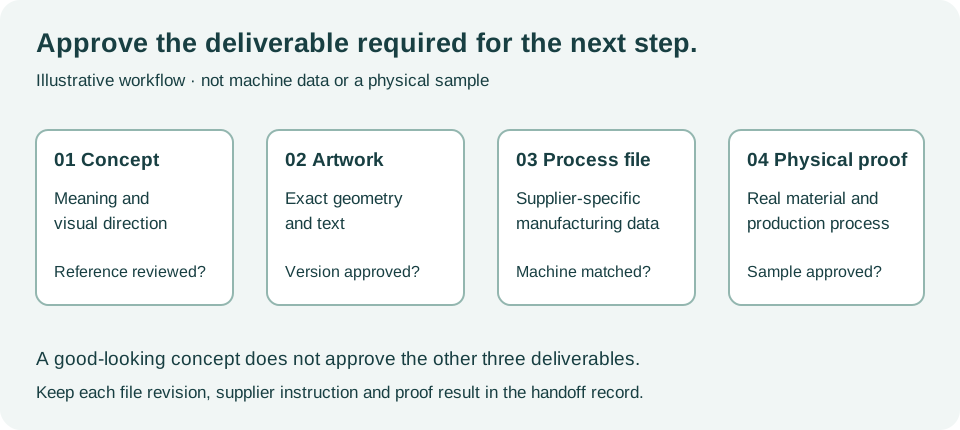
This original diagram describes stages, not a supplier-approved dieline.
CartVisual’s concept layouts help discuss the design. They do not establish manufacturing revisions, tooling rights or production authorization.
Use the production artwork handoff worksheet as a manual review record. Sample rows are fictional. It does not connect to, import into or modify an external store or production machine.
The downloadable worksheet currently has two fictional, pending examples: roll-label application and embroidery. Use its columns as a manual starting point and add the source, version, process and proof records required for this article. It does not contain completed checks for this project or certify a production file.
Sources and further reading
Recorded source-review dates are listed individually below. An undated source does not inherit the article’s publication date. Software and platform rules can change; check the current original before acting.
- CartVisual: editorial scope and evidence policy · Review date not separately recorded
- Pacdora: structural inputs for a dieline · Reviewed
Frequently asked questions
Are equal outside dimensions enough to reuse artwork unchanged?
No. Have the receiving supplier confirm the actual template and have a designer review the complete panel layout.
Who should own final release approval?
Agree a named release owner for your project and identify the drawing-and-artwork pair in the approval record.
Can an CartVisual concept SVG replace the new supplier’s drawing?
No. The receiving supplier must confirm the production structure and artwork requirements.
PREPARE ASSETS FOR YOUR NEXT STEP
Create supporting product assets in CartVisual.
Create new product creative assets in the workspace, then continue in your chosen tools. Third-party software procedures described in this guide take place in those applications; this workspace link does not imply an integration. Check current capabilities, account access and credit quotes.
Explore asset creation tools Check pricing and credits