 CartVisual
A+ product pages / PRACTICAL ANSWER
How do I make a product guide answer an AI shopping question without stuffing keywords?
Answer the actual selection question with evidence. Repeating search phrases cannot replace the facts needed to choose a product.
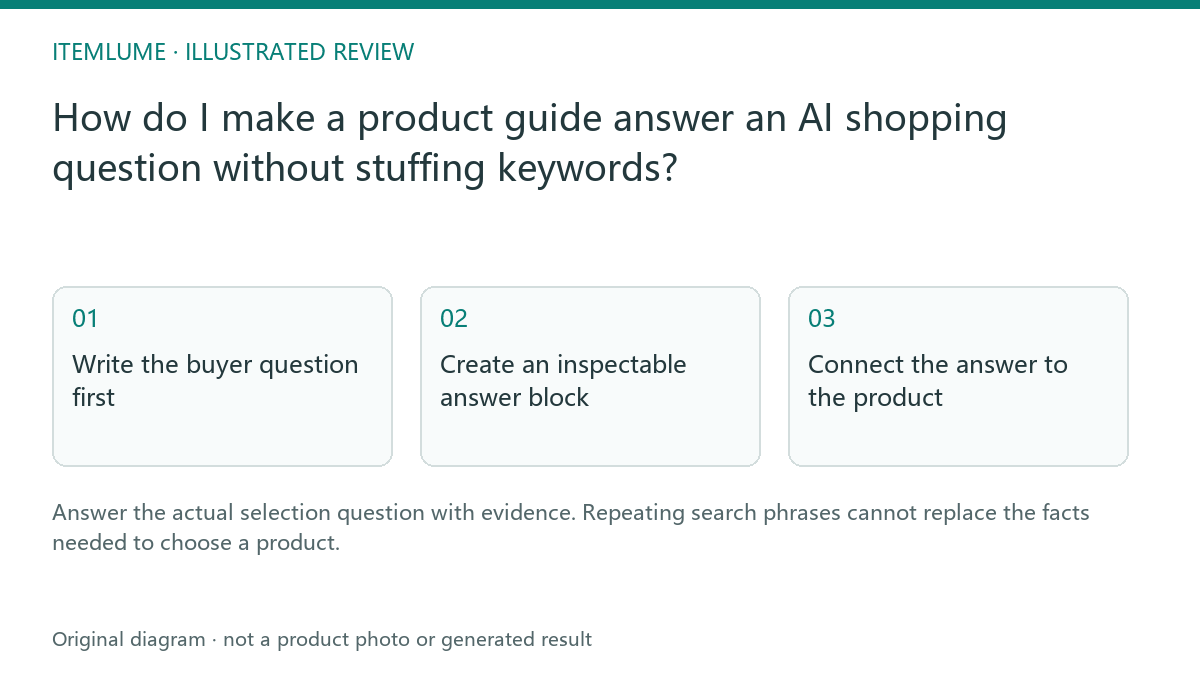
Write the buyer question first
A fictional seller hears “Will this organizer fit under my low shelf?” The useful answer needs external height, clearance and whether the handles extend above the body. A paragraph repeating “best AI-recommended organizer” does not provide those facts. Start with the actual question and the verified measurement basis before drafting promotional language.
Google’s AI search guidance emphasizes useful accessible content. Our recommendation is a small evidence table and a direct limitation statement, not a special command instructing assistants to recommend the brand.
Create an inspectable answer block
| Buyer uncertainty | Verified record | Visible answer role |
|---|---|---|
| Shelf fit | External height including handles | State the measurement basis |
| Access | Required lifting/removal clearance | Explain the practical check |
| Suitable option | Correct variant record | Link to the relevant product |
| Uncertainty | Buyer shelf measurements unavailable | Ask the buyer to measure |
Do not treat an AI-rendered scene under a shelf as a measured fit test. The table should distinguish documented product dimensions from missing customer information. Fictional examples can teach the method but must not be presented as real product specifications.
Fictional calculation only: assume a documented organizer is 290 mm high including its handles, a buyer reports 300 mm of opening height, and removal requires another 20 mm upward movement. The 10 mm static difference does not meet that assumed 20 mm lifting requirement. This example teaches the decision; none of these numbers describes an actual CartVisual product or measurement.
| Example check | Calculation or missing evidence | Honest answer |
|---|---|---|
| Static vertical gap | 300 − 290 = 10 mm | Height alone leaves a 10 mm gap |
| Required upward removal | 20 mm assumed requirement versus 10 mm gap | The stated lift-out route is not demonstrated as feasible |
| Other routes and directions | Front pull-out, width, depth and obstacles not checked | No overall fit or access approval |
| Unknown buyer opening | No actual customer measurement | Ask for the opening and intended access path |
Do not turn an arithmetic pass into a universal fit promise. Tolerances, hinges, shelf lips and the actual removal motion may change the answer. The responsible seller supplies real product dimensions; the buyer supplies real space measurements.
Connect the answer to the product
Link the explanation to the actual option and use consistent product terminology. Avoid saying “it fits” after listing several unrelated items. Readers and retrieval systems need a clear relationship between the answer, merchandise and evidence. State which options the answer does not cover instead of hiding exceptions in a distant disclaimer.
A generated image may illustrate how to measure, but the text must remain useful when that image is unavailable.
Put a conditional sentence next to the table: “For variant X, compare the documented outer dimensions and required access path with your measured opening; we cannot confirm fit from a staged image.” Replace X with the real option, and identify the measurement source. Use a tested option destination rather than a generic link that opens a different size.
Check retrieval and real reader usefulness
Ask a reviewer to make the selection using only the page. If they still need an unexplained dimension, improve the answer. After publication, monitor actual impressions, useful visits and observed citations separately. A page being readable by an assistant is not proof of natural recommendation, and a citation is not automatically a purchase.
The answer block is our editorial method, not Google’s required layout. Current Google guidance says there is no special AI schema or mandatory content chunk size. Verify the source chain, keep the useful text accessible, and report actual observed discovery without promising a citation.
Sources and further reading
Sources for this page were checked on . Platform rules can change; verify the current source before publishing. Prompt examples and workflow recommendations are CartVisual editorial guidance, not independently measured results.
Frequently asked questions
Do I need special AI instructions in the page?
Publish the useful answer and evidence for readers.
Can a rendered scene prove fit?
No. Use verified dimensions and customer measurements.
Does this guarantee a recommendation?
No. Monitor actual discovery and outcomes.
PREPARE ASSETS FOR YOUR NEXT STEP
Create supporting product assets in CartVisual.
Create new product creative assets in the workspace, then continue in your chosen tools. Third-party software procedures described in this guide take place in those applications; this workspace link does not imply an integration. Check current capabilities, account access and credit quotes.
Explore asset creation tools Check pricing and credits