 CartVisual
Product images / PRACTICAL ANSWER
Should my reference photo include arrows, measurements and review notes?
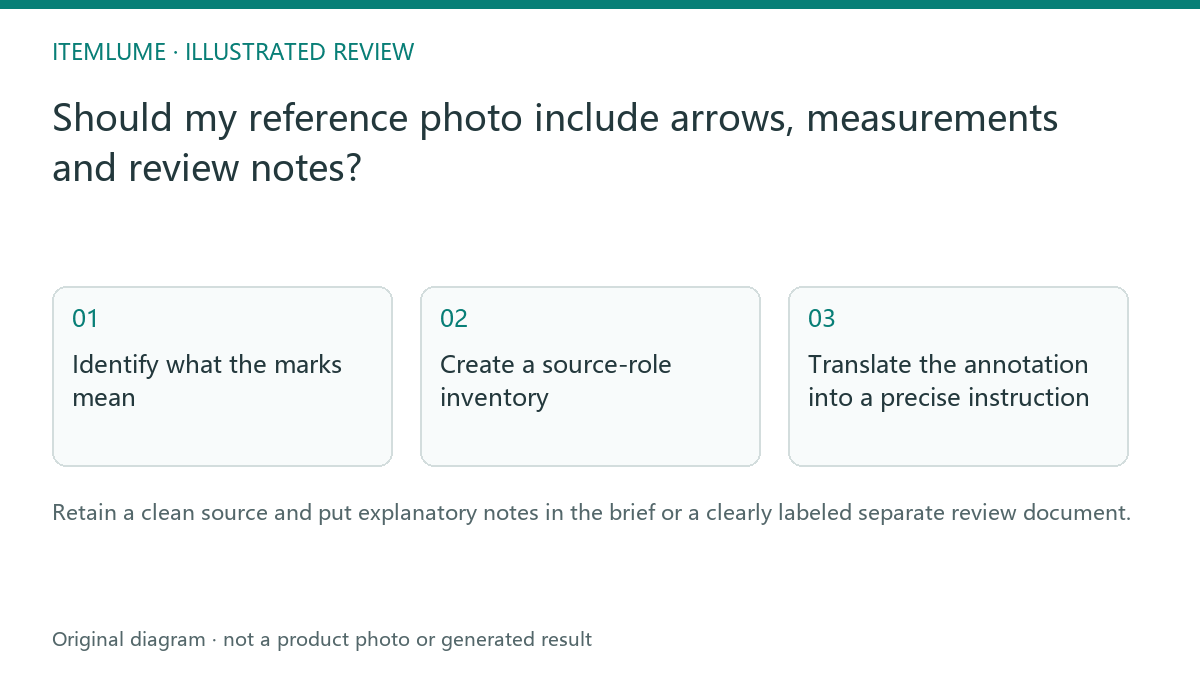
Retain a clean source and put explanatory notes in the brief or a clearly labeled separate review document.
Identify what the marks mean
A fictional bottle seller draws a red circle around a faulty cap and writes “keep this shape” on a screenshot. If that screenshot becomes the only product image, a generator may interpret the circle or lettering as part of the scene. The annotation helps a human reviewer but can contaminate the visual source.
Use the untouched approved image as the merchandise reference. Keep the marked comparison separately with a clear review role. Do not remove a real printed label under the assumption that every visible word is an annotation.
Create a source-role inventory
| Asset | Role | Submission decision |
|---|---|---|
| Clean product photo | Merchandise evidence | Use as the approved product source |
| Arrowed screenshot | Human explanation | Keep separate and clearly described |
| Measured drawing | Dimension evidence | State its role and verified origin |
| Rejected result | Defect comparison | Do not mislabel as approved merchandise |
This inventory prevents explanatory material from masquerading as the sold product. It does not guarantee that every tool accepts multiple reference roles; follow the actual supported interface.
Translate the annotation into a precise instruction
For the cap, write that its outline, rib count where visible and relationship to the neck must match the approved source. Describe the defect without embedding a colored repair circle in the scene. Fictional brief: “Use the clean source as the product authority. Keep the visible cap outline and ribs; the red circle in the separate review document marks the area to inspect and is not product printing.” Only use a separate reference slot if the actual interface supports its stated role; otherwise keep the marked document out of the visual submission. A measurement note should come from a verified record, not a ruler drawn over an uncalibrated photograph.
If the useful reference is only a screenshot, obtain the original where possible. Retain the screenshot for review history, then prepare a clean authorized source for the creative task. If annotation covers an unknown seam or label, do not erase-and-generate the obscured region and call it recovered product evidence. Obtain a usable real source or mark that detail unavailable.
Check for annotation leakage
Inspect output for arrows, circles and review notes, but do not infer the cause from the output alone. Retain the clean source, review copy, actual submitted file and prompt so their roles can be checked.
| Observation | Next check | Action |
|---|---|---|
| Submitted file contains a red review circle | Compare it with the intended clean original. | Correct the source selection before an authorized new request. |
| Submitted file is clean but output adds an arrow | Review the actual prompt, selected task and result. | Record an added graphic defect; source contamination is not established. |
| Original label really contains a printed symbol | Check the approved product photograph, not just the marked screenshot. | Preserve genuine printing; do not remove it as if it were review markup. |
For a storyboard, review every isolated scene as well. The ordinary image workflow does not guarantee that explanatory marks stay invisible or parse an annotated technical drawing as verified dimensions. No annotation-leakage experiment was run for this guide. The public headphone example is a separate development test, not evidence of annotation-aware parsing. Use the defect-report format for the retained observation and file references.
Sources and further reading
Recorded source-review dates are listed individually below. An undated source does not inherit the article’s publication date. Software and platform rules can change; check the current original before acting.
- CartVisual: editorial scope and evidence · Review date not separately recorded
- CartVisual: owned headphone reference and actual image test · Reviewed
Frequently asked questions
Can review circles appear in the output?
They can be interpreted as visible image content.
Should I remove genuine product label text?
No. Distinguish real printing from review annotations.
Do drawn rulers prove dimensions?
Use a verified measurement source.
PREPARE ASSETS FOR YOUR NEXT STEP
Create supporting product assets in CartVisual.
Create new product creative assets in the workspace, then continue in your chosen tools. Third-party software procedures described in this guide take place in those applications; this workspace link does not imply an integration. Check current capabilities, account access and credit quotes.
Explore asset creation tools Check pricing and credits