 CartVisual
Assets & tasks / PRACTICAL ANSWER
Should my unfinished creative demo be discoverable in search?
Publish an approved example with context. Keep unfinished staging and private customer work under their intended access controls.
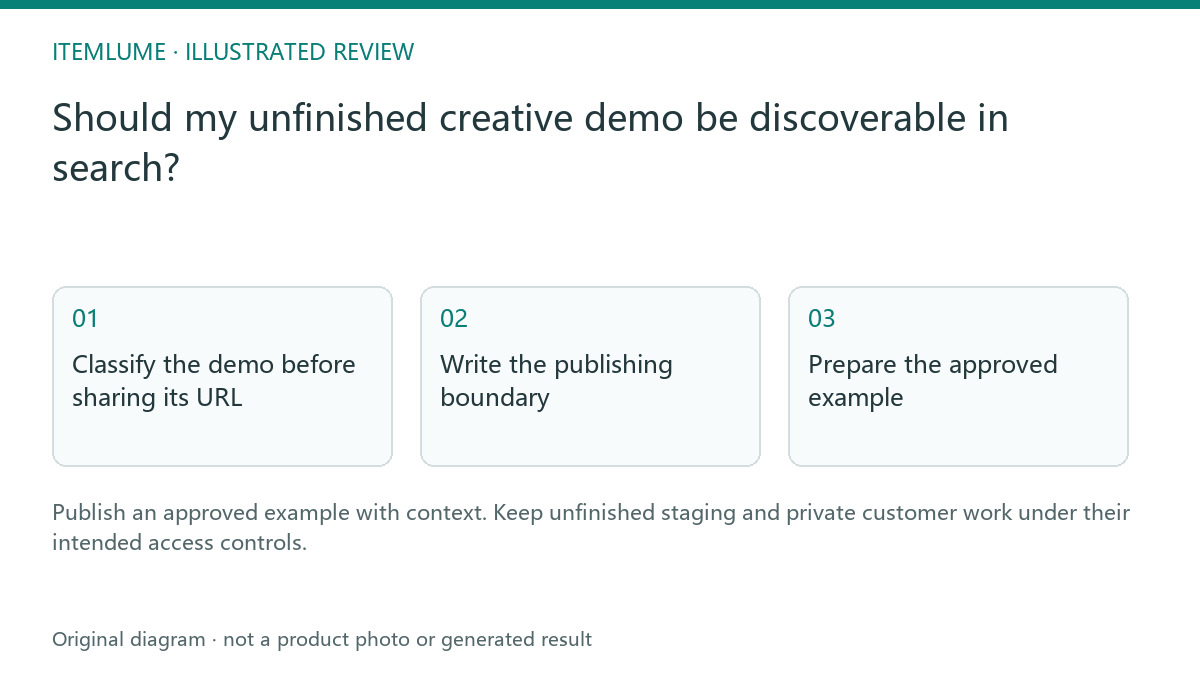
Classify the demo before sharing its URL
A fictional studio has a public headphone example, a development preview and a private customer bottle draft. Those URLs serve different audiences. The public example can explain actual inputs and limitations; the development preview changes without editorial approval; the customer draft may include confidential packaging. Do not submit all three to a sitemap simply because they render in a browser.
Start with permission and content status, then choose delivery controls. A noindex instruction is not authentication and should not be treated as protection for sensitive customer work.
Write the publishing boundary
| Asset | Audience | Intended handling |
|---|---|---|
| Owned reviewed example | Public readers | Stable page with source context |
| Unfinished staging preview | Development team | Controlled staging environment |
| Customer draft | Authorized customer/team | Private access |
| Public worksheet | Readers | Fictional sample data only |
Check that the actual hosting configuration matches this record. Private app routes should not become public just to make AI retrieval easier. A publicly accessible screenshot can reveal information even when its containing page is excluded from search.
Google’s noindex documentation requires the crawler to reach a resource to read its noindex instruction. Blocking that URL in robots.txt can prevent this. A robots block alone can still leave a linked URL in results. Choose access controls for private material; treat search-exclusion instructions as a separate purpose.
Prepare the approved example
Describe which model calls actually ran, which results were rejected and which limitations remain. Use assets that are authorized for publication. Link to the useful workflow explanation and separate illustrative annotations from test evidence. Avoid presenting a static mockup as a verified integration or claiming average quality from one selected example.
For the headphone page, the source-to-result comparison is the valuable content. A model name alone provides much less information about what a seller should inspect.
Verify the public and private routes
Inspect the published example anonymously and confirm its intended media are available. Separately test that private and staging material is not exposed through public navigation, catalog files or sitemaps. Website access changes happen in the hosting implementation. This guide does not recommend exposing private CartVisual tasks or changing crawler blocks on authenticated tools.
| Test anonymously | Expected observation | What it establishes |
|---|---|---|
| Approved public example | Authorized page and intended public media load | Public readability at the time tested |
| Private draft page and direct media URL | Unauthorized access is denied for both | The checked resources require access |
| Public but search-excluded draft, if deliberately used | Crawler-readable noindex and correct public exposure decision | Search instruction present; content is still public |
| Public discovery files | Only approved public entries appear | No accidental discovery entry in the checked inventory |
Record actual URLs, access mode and observation time. Do not paste a confidential customer URL into a public validator. An empty sitemap entry list does not prove direct media protection. If private media are exposed, restrict access first and follow an appropriate removal process; adding noindex does not reverse disclosure. See the separate support/public evidence decision.
Sources and further reading
Recorded source-review dates are listed individually below. An undated source does not inherit the article’s publication date. Software and platform rules can change; check the current original before acting.
- CartVisual: editorial scope and evidence · Review date not separately recorded
- Google Search Central: AI search optimization guidance · Review date not separately recorded
- CartVisual: owned headphone reference and actual image test · Review date not separately recorded
- Google: prevent indexing with noindex · Reviewed
Frequently asked questions
Does noindex protect confidential drafts?
No. Use appropriate access controls for private material.
Can an owned development result become a public example?
After permission, editorial review and clear test limitations.
Should private app URLs enter the sitemap?
No. Keep the public discovery inventory separate.
Should I combine a robots block with noindex and assume removal?
No. Google must access the resource to read noindex. Keep confidential material behind real access controls and verify the chosen search-exclusion method separately.
PREPARE ASSETS FOR YOUR NEXT STEP
Create supporting product assets in CartVisual.
Create new product creative assets in the workspace, then continue in your chosen tools. Third-party software procedures described in this guide take place in those applications; this workspace link does not imply an integration. Check current capabilities, account access and credit quotes.
Explore asset creation tools Check pricing and credits