 CartVisual
DIAGNOSTIC GUIDE / A+ product pages
Should I write an English brief when I want a French product description?
For Shopify’s documented description workflow, write the prompt in French when you want French output; English is not a required briefing language. Keep verified English source facts and protected model codes beside the draft, and review the French meaning with an appropriate target-language reviewer. Other writing tools may offer separate language controls, so check the actual tool before assuming the same behavior.
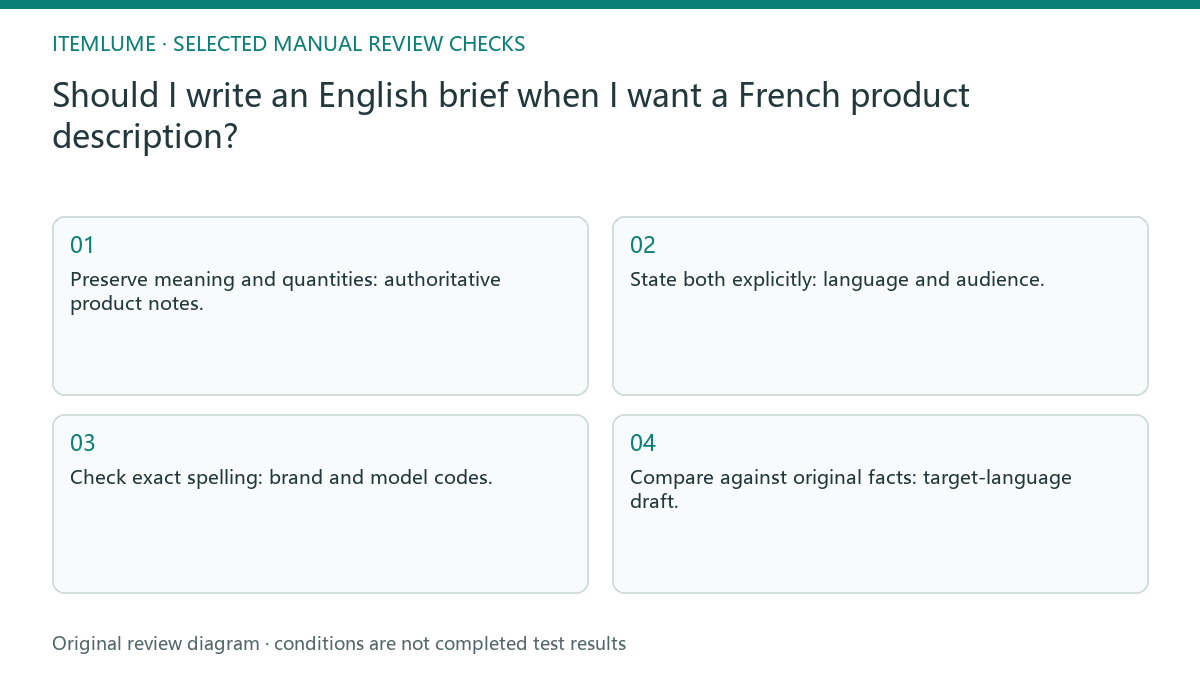
Brief language and publish language are separate choices
Input language, output language and immutable terms serve different purposes. Translating the briefing notes first can introduce a second opportunity for numeric or naming errors. Conversely, leaving every marketing phrase untranslated produces mixed-language copy. Define which material should change and which should remain exact.
Choose the language using the actual tool’s documented behavior. Shopify currently says generated descriptions match the prompt language and recommends writing the prompt in the desired description language. For French copy in that workflow, use a French prompt and retain protected brand/model terms and verified facts. In another tool with a separate output-language control, confirm that setting rather than assuming English instructions work identically everywhere. Language changes do not authorize invented prices, services, measurements or product facts.
Lock names and facts before translating the draft
Prepare three blocks: verified facts, the requested language and audience, and exact terms not to translate. Give approved spellings where available. Review the draft line by line for names, numbers and units, then have an appropriate target-language reviewer check meaning and naturalness before applying it to imagery or the store.
Separate instructions about tone from the facts to preserve. Provide the reviewer a source sentence and its proposed output side by side. Ask whether quantities, limitations and use conditions survived, not merely whether the translation sounds natural.
- Preserve meaning and quantities: authoritative product notes.
- State both explicitly: language and audience.
- Check exact spelling: brand and model codes.
- Compare against original facts: target-language draft.
An English fact record for a French listing
Fictional exercise: a verified English fact record describes a pouch, and the operator prepares a French prompt for the documented Shopify workflow. “Luma-P2” remains the exact product code, while the benefit sentence is translated. The reviewer compares the French draft with the fact block rather than guessing from the photograph. No language setting certifies the result as error-free.
For the same fictional French listing, the verified English fact block says the pouch has a removable component and includes a limited set. The French draft must preserve both meanings, with Luma-P2 unchanged. Reject a fluent sentence that invents sterilization or expands the included set. This is an editorial comparison example, not evidence that any tool generated an approved French result.
Check meaning rather than surface fluency
Stop if an untranslated term has no approved interpretation or if the target-language reviewer cannot confirm a claim. Keep the ambiguity visible instead of silently resolving it with AI.
Record the approved terms for the next revision. If the product changes, revisit those facts instead of treating the prior translation as a permanent specification. CartVisual can help draft requested-language copy from confirmed inputs. It does not establish regional policy, translate packaging facts automatically or replace a qualified language review.
Fact source to human review: decision worksheet
| Check | Evidence to record | Review action |
|---|---|---|
| Fact source | Authoritative product notes | Preserve meaning and quantities |
| Output request | Language and audience | State both explicitly |
| Fixed terms | Brand and model codes | Check exact spelling |
| Human review | Target-language draft | Compare against original facts |
Use this matrix as a manual review record and add your own real evidence. Its conditions are not completed test results.
Sources and further reading
Recorded source-review dates are listed individually below. An undated source does not inherit the article’s publication date. Software and platform rules can change; check the current original before acting.
- CartVisual: editorial policy and product scope · Review date not separately recorded
- Shopify: Automatically generating product descriptions · Reviewed
Frequently asked questions
Does an English brief force English output?
In Shopify’s currently documented workflow, generated descriptions match the prompt language and Shopify recommends prompting in the desired description language. For another tool, check its actual output-language controls. In either case preserve exact facts and review the target-language meaning.
May translation localize prices automatically?
No. Use a confirmed price and currency rather than an invented conversion.
What should a reviewer compare?
Source and output meaning, especially names, quantities, limitations and included parts.
PREPARE ASSETS FOR YOUR NEXT STEP
Create supporting product assets in CartVisual.
Create new product creative assets in the workspace, then continue in your chosen tools. Third-party software procedures described in this guide take place in those applications; this workspace link does not imply an integration. Check current capabilities, account access and credit quotes.
Explore asset creation tools Check pricing and credits