 CartVisual
DIAGNOSTIC GUIDE / Product videos
Can generated liquid motion change buyers' expectations of the real texture?
Generated liquid motion can imply a texture the real product does not have. Use an approved real observation of the same product state and comparable handling conditions before accepting a pour, drip or stretch. A cinematic appearance is not a viscosity measurement. Keep the visual comparison separate from product performance or ingredient claims, and reject movement that depends on unsupported material behavior.
Record the actual observation conditions
Ask the product owner for an approved sample observation: container, product version, temperature context, angle and handling action. Do not establish a test standard here or manipulate the product to force a desired motion. Different conditions can make a casual comparison misleading.
The reference should show the action relevant to the ad, not merely a closed bottle. A packaging photograph does not establish pour speed or stringing. If the action is undocumented, choose a supported static or container-focused shot while obtaining the missing real evidence.
Describe visible behavior without inventing a property
Record what the approved reference actually shows: where the stream starts, how it separates, and how the surface moves. Avoid an invented technical value or a phrase such as “rich formula” inferred solely from a long generated string. Copy needs separate approved facts.
Compare the generated action at the same relevant interval. Look for an unsupported persistent thread, slow mound or splash pattern that changes the buyer’s expectation. Lighting and shot style may vary, but the brief should not ask a thin product to act like a thick one for drama.
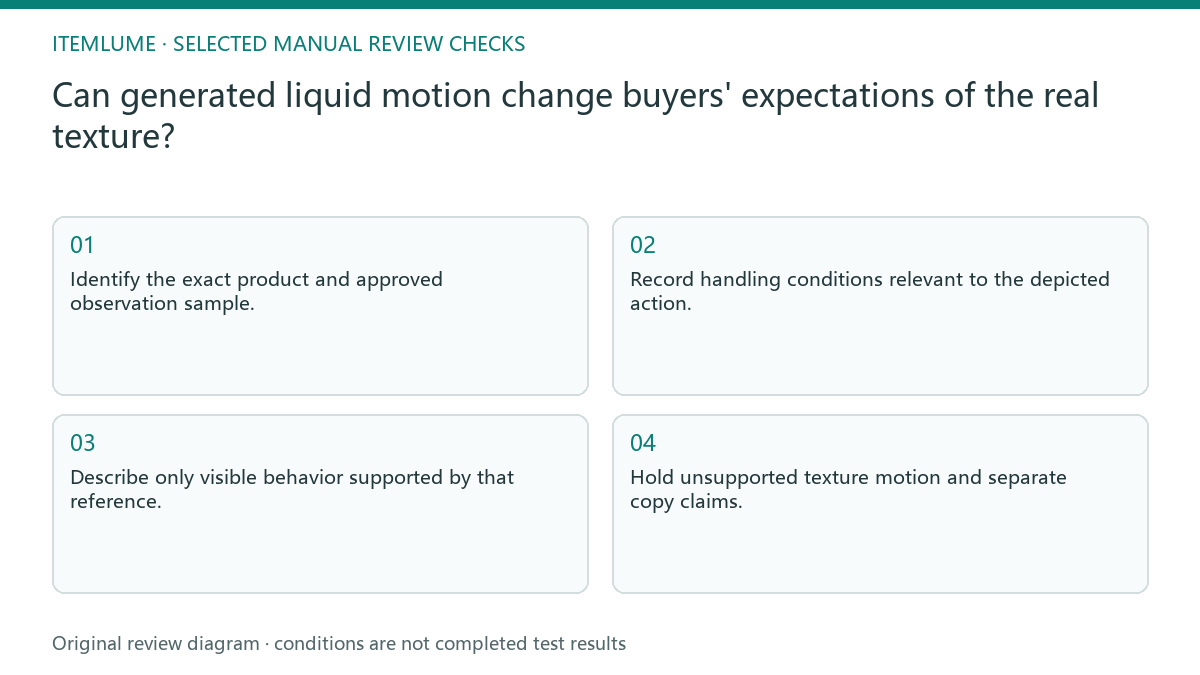
- Identify the exact product and approved observation sample.
- Record handling conditions relevant to the depicted action.
- Describe only visible behavior supported by that reference.
- Compare the generated pour or drip at the corresponding interval.
- Hold unsupported texture motion and separate copy claims.
Fictional exercise: a serum becomes a long thread
This fictional exercise uses a serum whose approved observation shows a short break in a drip. A generated candidate maintains a long elastic-looking strand. The scenario is invented, not a viscosity experiment or a product claim about a real cosmetic.
The reviewer removes the unsupported stretching action and proposes a supported container reveal instead. If another action is desired, the owner supplies its actual reference first. The stopping decision is based on the visual evidence, not on which candidate feels more luxurious.
Approve the motion’s meaning after the final edit
Keep the final cut’s source/action identity, comparison interval and any speed or reverse treatment with the real observation record. Review the motion again after a retime; a shorter edit or slow playback can change what the strand or pour appears to demonstrate. An FTC U.S. advertising case discusses misleading altered product demonstrations and a short fictionalization disclaimer that did not resolve the overall impression. That case is not a viscosity standard or proof about this serum. Remove unsupported motion rather than claiming a label, attractive render or manual visual comparison establishes material performance.
Stop when the depicted behavior is supported by the real reference under the stated comparison, or remove the unsupported action. CartVisual video creation does not perform material measurement. Do not describe a manual visual review as laboratory evidence, efficacy validation or a guaranteed match for every product batch.
Liquid-motion evidence check
| Observation | Manual check | Stop or approve |
|---|---|---|
| Closed bottle only | Obtain action reference | Hold texture inference |
| Different conditions | Record handling context | Compare only supported action |
| Generated long strand | Compare real separation | Reject unsupported stretch |
| Retimed final clip | Review motion meaning | Renew action approval |
Use this matrix as a manual review record and add your own real evidence. Its conditions are not completed test results.
Sources and further reading
Recorded source-review dates are listed individually below. An undated source does not inherit the article’s publication date. Software and platform rules can change; check the current original before acting.
- CartVisual: editorial policy and product scope · Review date not separately recorded
- Product photography tips(Adobe Express) · Review date not separately recorded
- FTC: Less than meets the eye? · Reviewed
- FTC: Advertising FAQs for small business · Reviewed
Frequently asked questions
Can a picture prove viscosity?
No. This guide compares visible actions and supplies no technical material measurement.
Can I add a richer-texture claim?
Only with separate owner-approved product evidence, not because the generated motion looks thick.
What if no pour reference exists?
Use an approved supported shot and obtain actual evidence before making the action claim.
PREPARE ASSETS FOR YOUR NEXT STEP
Create supporting product assets in CartVisual.
Create new product creative assets in the workspace, then continue in your chosen tools. Third-party software procedures described in this guide take place in those applications; this workspace link does not imply an integration. Check current capabilities, account access and credit quotes.
Explore asset creation tools Check pricing and credits