 CartVisual
DIAGNOSTIC GUIDE / Assets & tasks
Why does my WebP work as a product image but fail as a Shopify collection image?
Check the destination before remaking the image. Shopify’s reviewed guidance distinguishes collection images from product media and Files: a WebP accepted in one place can still be rejected in another. Preserve the approved product appearance and convert a separate delivery copy if required. The key comparison is the same approved image in two different upload locations.
Why the upload location changes the answer
A valid image and a supported destination are different checks. Renaming the extension does not convert the encoded file. A successful product upload therefore does not certify the same file for a collection cover, and an error at the collection stage does not prove the original creative is defective.
Start from the collection editor itself. If its current help confirms a different accepted format, the product-gallery result is merely a comparison. Inspect whether the selected asset is the converted copy, because identical thumbnails can hide different encodings.
Use the collection-specific requirement
The reviewed Shopify guidance explicitly lists WebP as unsupported for collection images even though products and Files accept it. Choose a delivery format for the collection destination, not from the product-gallery result.
| Delivery record | Keep separate |
|---|---|
| Approved master | Original file and accepted appearance |
| Collection copy | Encoding, output name and crop |
| Transparency decision | Intended background if the copy is opaque |
| Saved result | Reopened cover, not only its thumbnail |
If the new format still fails, retain the exact error and check other requirements before changing the composition.
Convert a copy in the collection workflow
Open the actual collection editor and retain its exact message. Compare the same approved asset in the product media area and the intended collection position. Export a new supported-format copy in an editor, preserve the crop, and verify that the new filename describes its destination rather than replacing the master.
In the conversion editor, preserve the chosen crop and compare transparent edges against the intended background. A white JPEG background may be acceptable for the approved cup image but unsuitable for a transparent logo; the destination and visual decision both need an owner.
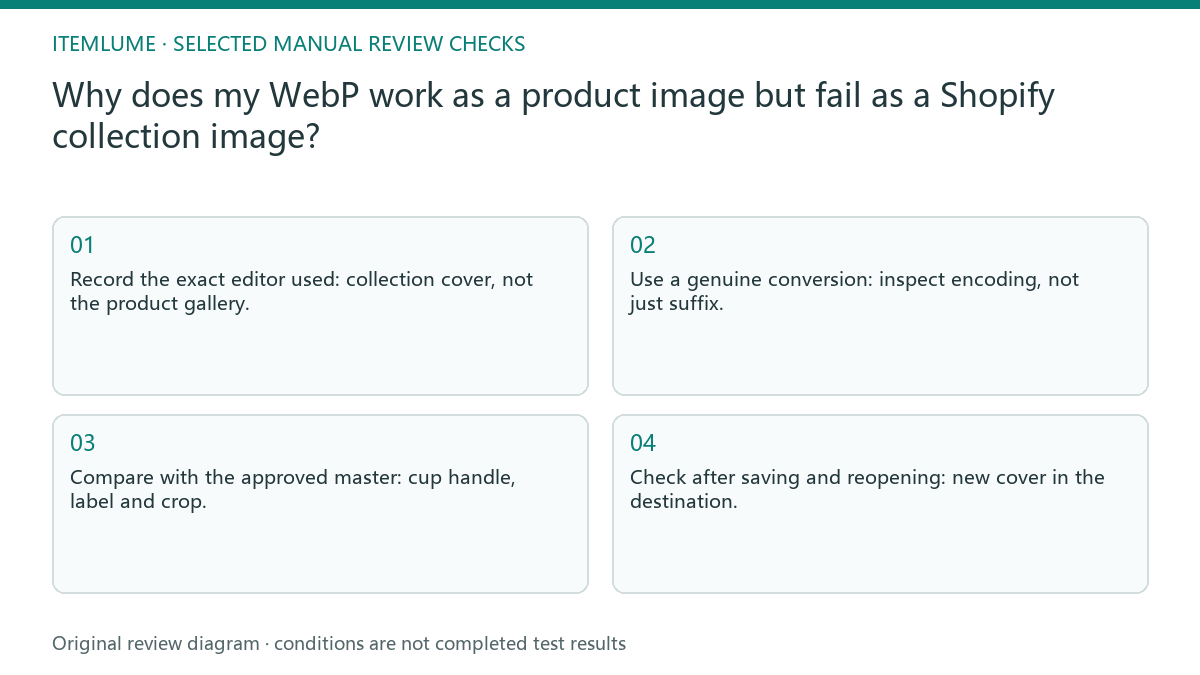
- Record the exact editor used: collection cover, not the product gallery.
- Use a genuine conversion: inspect encoding, not just suffix.
- Compare with the approved master: cup handle, label and crop.
- Check after saving and reopening: new cover in the destination.
A cup image accepted in only one destination
Fictional exercise: a ceramic-cup WebP is already visible on a product page but fails as the collection cover. Keep that original. Make a separate JPEG delivery copy, check the cup’s handle and label against the master, and upload only to the collection under review. The exercise does not establish a universal pixel requirement.
Reopen the saved collection rather than judging the upload thumbnail. Compare the cover as a shopper sees it, then keep the product-gallery version unchanged. If conversion works, the conclusion applies to this delivery path, not to every Shopify image slot.
When to stop regenerating the photograph
Stop repeated uploading when the exact target still rejects a correctly converted file. Record the file details and message for Shopify support instead of spending generation credits on the same photograph.
For persistent rejection, attach the actual converted file and target error to the support question. Changing a prompt cannot repair an external editor’s format contract. The store operator verifies the accepted collection cover in Shopify. CartVisual supplies a reviewed creative candidate; file conversion and the external upload remain separate actions.
Target position to accepted result: decision worksheet
| Check | Evidence to record | Review action |
|---|---|---|
| Target position | Collection cover, not the product gallery | Record the exact editor used |
| Actual file format | Inspect encoding, not just suffix | Use a genuine conversion |
| Visual match | Cup handle, label and crop | Compare with the approved master |
| Accepted result | New cover in the destination | Check after saving and reopening |
Use this matrix as a manual review record and add your own real evidence. Its conditions are not completed test results.
Sources and further reading
Recorded source-review dates are listed individually below. An undated source does not inherit the article’s publication date. Software and platform rules can change; check the current original before acting.
- CartVisual: editorial policy and product scope · Review date not separately recorded
- Shopify: Adding product media · Reviewed
Frequently asked questions
Should I rename .webp to .jpg?
No. Export a genuinely encoded JPEG copy in an editor; changing the suffix alone leaves the underlying data unchanged.
Must I regenerate an accepted product photograph?
A destination-format error alone does not justify regeneration. Try the required delivery conversion while preserving the approved creative.
Does this prove every collection accepts the file?
No. Confirm the current requirements and saved result at your actual collection editor.
PREPARE ASSETS FOR YOUR NEXT STEP
Create supporting product assets in CartVisual.
Create new product creative assets in the workspace, then continue in your chosen tools. Third-party software procedures described in this guide take place in those applications; this workspace link does not imply an integration. Check current capabilities, account access and credit quotes.
Explore asset creation tools Check pricing and credits