 CartVisual
DIAGNOSTIC GUIDE / Assets & tasks
Will saving an AI-generated description immediately change my live product page?
Treat saving a description on a published product as a potentially live action. Shopify’s current generation help explains that saving a new description on a published product updates its content. Review in a separate copy, preserve the current approved text, and check the public page after an authorized save. An AI draft or CartVisual writing result is not automatically an isolated store staging environment.
Identify the product’s publication state
Before pasting text, record the product, selected locale and publication state. A draft item and a published item create different risks even when the editor looks similar. Confirm the current store workflow instead of assuming that every save is only a private draft.
Copy the existing description into a retained review record with its version and date. Preserve formatting or linked information needed for a return to the approved content. A vague memory of the previous headline is not enough to restore a description after an unwanted change.
Approve copy outside the live editor
Review the proposed description in a separate document or an actual supported store review workflow. Check product facts, variant scope, claims and language before applying it. CartVisual text assistance can help draft, but does not authorize a storefront change or maintain a store rollback for you.
Agree who may perform the save and how the previous approved text will be restored if needed. Do not introduce an imaginary preview-only button or staging integration. If the current tool’s save behavior is unclear, stop and ask the store owner before using the published record for experiments.
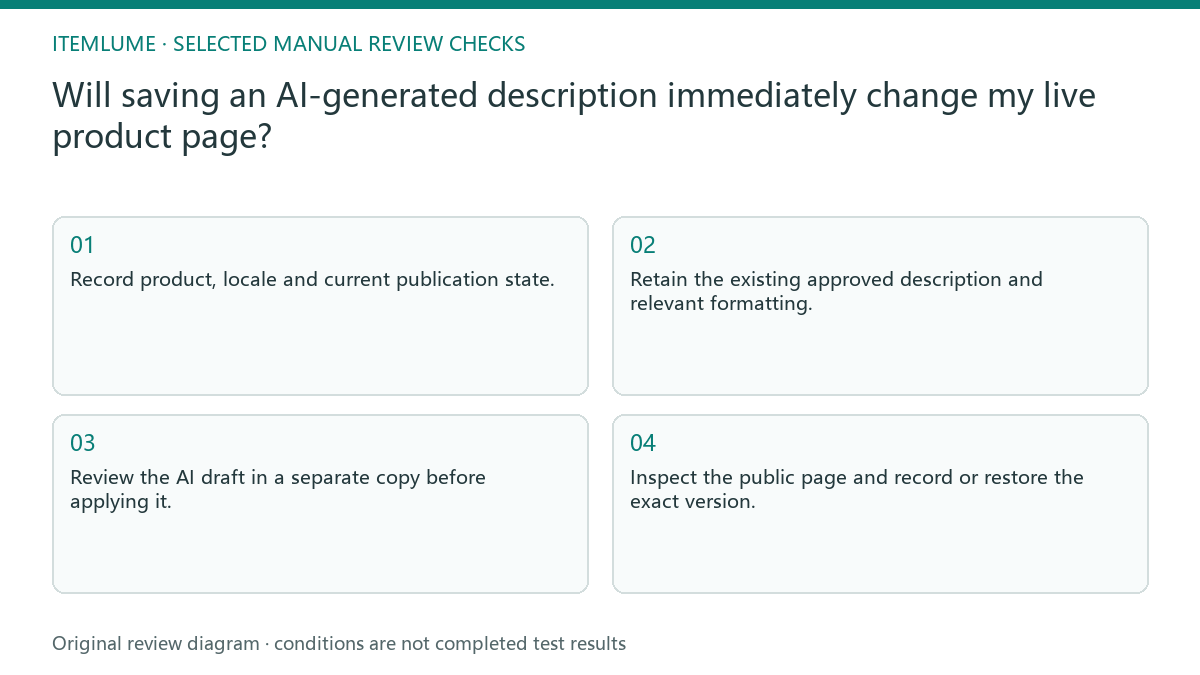
- Record product, locale and current publication state.
- Retain the existing approved description and relevant formatting.
- Review the AI draft in a separate copy before applying it.
- Have the authorized operator perform the agreed save.
- Inspect the public page and record or restore the exact version.
Fictional exercise: a draft label does not isolate the store
In this fictional exercise, a merchant pastes a draft into a published mug’s description and presses save, believing the draft label prevents publication. The live wording changes. The invented scenario illustrates the workflow boundary; it is not an CartVisual-connected store test.
The authorized operator restores the retained approved text and moves further review into a separate copy. They inspect the public product page again rather than assuming restoration succeeded. The stop condition is the intended public version, not the disappearance of an editing warning.
Close the public-page verification
Shopify’s current description-generation instructions state that saving updates published products right away. Keep a concise release receipt: exact product identifier and public URL, locale, approved text revision, authorized save time and who compared the public result. Check important formatting and links against the retained approved copy. Record an unexpected public result as unresolved and use the owner-agreed restoration process; the retained text is not an automatic transactional rollback feature. A private preview or another locale cannot stand in for that exact public-page check.
If the public version disagrees or contains unsupported claims, keep the release on hold and follow the agreed restoration plan. Store publishing remains external manual work. Stop when the intended page is verified and the saved record can support the next review without exposing private account data.
Draft-to-live save check
| Observation | Manual check | Stop or approve |
|---|---|---|
| Published item | Confirm save behavior | Treat as live action |
| Review incomplete | Use separate copy | Hold application |
| Old text needed | Retain exact version | Restoration possible |
| Save completed | Check public locale | Approve intended result |
Use this matrix as a manual review record and add your own real evidence. Its conditions are not completed test results.
Sources and further reading
Recorded source-review dates are listed individually below. An undated source does not inherit the article’s publication date. Software and platform rules can change; check the current original before acting.
- CartVisual: editorial policy and product scope · Review date not separately recorded
- Shopify: Automatically generating product descriptions · Reviewed
Frequently asked questions
Does an AI draft publish itself?
Drafting and store saving are separate actions; the actual save behavior belongs to the store workflow.
Is private preview sufficient?
No. Verify the actual public product and locale after the agreed save.
Does CartVisual retain my store’s old description?
Do not assume a store rollback integration; retain the approved text externally.
PREPARE ASSETS FOR YOUR NEXT STEP
Create supporting product assets in CartVisual.
Create new product creative assets in the workspace, then continue in your chosen tools. Third-party software procedures described in this guide take place in those applications; this workspace link does not imply an integration. Check current capabilities, account access and credit quotes.
Explore asset creation tools Check pricing and credits