 CartVisual
A+ product pages / PRACTICAL ANSWER
How do I describe a nominal product size without implying every unit is identical?
Use the maker’s actual nominal values and documented variation. Do not invent a tolerance or imply an exact fit from a rounded label.
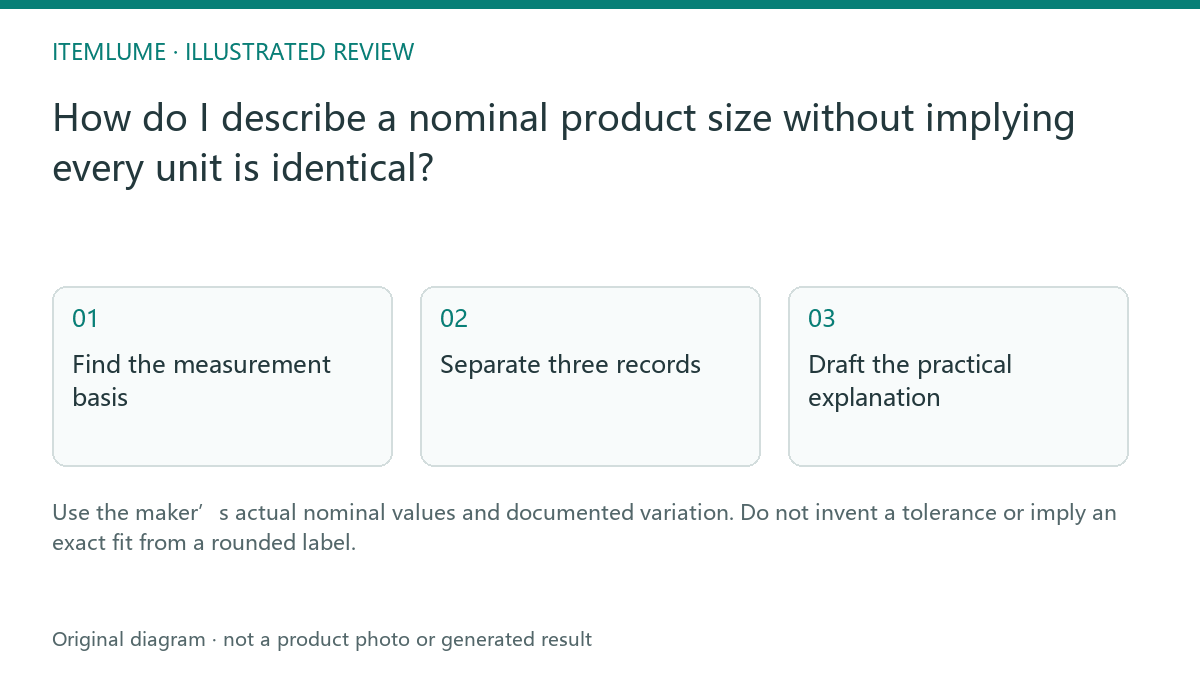
Find the measurement basis
A fictional handmade tray is described as approximately 30 cm wide. A generated specification paragraph changes that to exactly 300.00 mm and says it fits every 30 cm shelf. The rewrite adds precision and a fit promise. Obtain the maker’s measurement basis and any established variation before choosing the wording.
A unit conversion does not improve the underlying measurement certainty. If no tolerance record exists, keep that uncertainty explicit rather than asking the model for a plausible plus-or-minus number.
NIST’s unit-conversion guidance includes selecting appropriate significant digits and rounding. Conversion changes the unit, not the quality of the underlying measurement. “Approximately 30 cm” must not silently become “exactly 300.00 mm.” Nor does a more detailed display create a documented manufacturing tolerance.
Separate three records
| Record | Source | Copy boundary |
|---|---|---|
| Nominal size | Maker specification | State the documented basis |
| Variation | Actual maker measurement/process record | Do not invent a tolerance |
| Buyer fit | Customer opening and required clearance | Do not infer from nominal size alone |
The table is an editorial worksheet, not a dimensional engineering standard. Products with critical fit requirements need appropriate qualified measurement and responsible review.
| Information available | What it can support | What it cannot establish |
|---|---|---|
| Maker nominal target only | The documented nominal/approximate description | An invented ± tolerance |
| Measured range from a few units | Those observed samples, method and conditions | A production-wide guaranteed range |
| Maker’s applicable tolerance record | That defined specification and scope | Fit in every customer opening |
| Customer opening and access path | A specific comparison when product bounds are known | Fit based only on a staged shelf image |
This is an editorial distinction, not a tolerance standard or inspection plan. Keep nominal values, measured observations and a maker’s acceptance specification in separate fields. A finite sample’s narrow range is not automatically the process tolerance.
Draft the practical explanation
Explain how the buyer should interpret the stated size and where the verified detailed record can be found. Avoid wording that makes a handmade approximate dimension sound like a certified gauge. If a product requires clearance, use an established requirement instead of silently rounding it away.
For the tray example, a useful explanation distinguishes the nominal width from a guarantee of fitting a particular shelf. A generated scene on a shelf supplies visual context, not the customer’s actual measurements.
For a fictional 300 mm nominal tray and a 300 mm shelf opening, even an exactly equal nominal number provides no positive clearance. If actual maximum tray width, opening measurement or required access gap is unknown, leave fit unconfirmed. Do not invent 1 mm, 5 mm or any other tolerance to make the comparison pass. Use a conditional fit answer once the real records exist.
Review the specification image too
Compare the description, dimension graphic and product-selection text. A careful paragraph cannot repair a large “EXACT FIT” label in an image. CartVisual can illustrate measurements from supplied facts, but it does not measure the physical units or establish production tolerances. Keep the approved maker record linked to the published claim.
If a diagram conflicts with the description, hold both until the responsible maker confirms the basis. Keep the measurement source and its scope beside the published claim. This method does not certify dimensions or replace qualified review for a fit-critical product.
Sources and further reading
Recorded source-review dates are listed individually below. An undated source does not inherit the article’s publication date. Software and platform rules can change; check the current original before acting.
- CartVisual: editorial scope and evidence · Review date not separately recorded
- Shopify: reviewing automatically generated descriptions · Review date not separately recorded
- NIST: unit conversion and significant digits · Reviewed
- Shopify: review generated descriptions · Reviewed
Frequently asked questions
Does converting units add certainty?
No. Preserve the underlying measurement basis.
Can AI supply a missing tolerance?
Use established maker information, not a guessed value.
Does a rendered shelf prove fit?
No. Use actual product and customer measurements.
PREPARE ASSETS FOR YOUR NEXT STEP
Create supporting product assets in CartVisual.
Create new product creative assets in the workspace, then continue in your chosen tools. Third-party software procedures described in this guide take place in those applications; this workspace link does not imply an integration. Check current capabilities, account access and credit quotes.
Explore asset creation tools Check pricing and credits