 CartVisual
Assets & tasks / PRACTICAL ANSWER
What does restoring the previous shot do after a TVC retake fails?
Restoration reuses the eligible previous successful shot and film state. It does not generate a new repair or certify that the old shot is accurate.
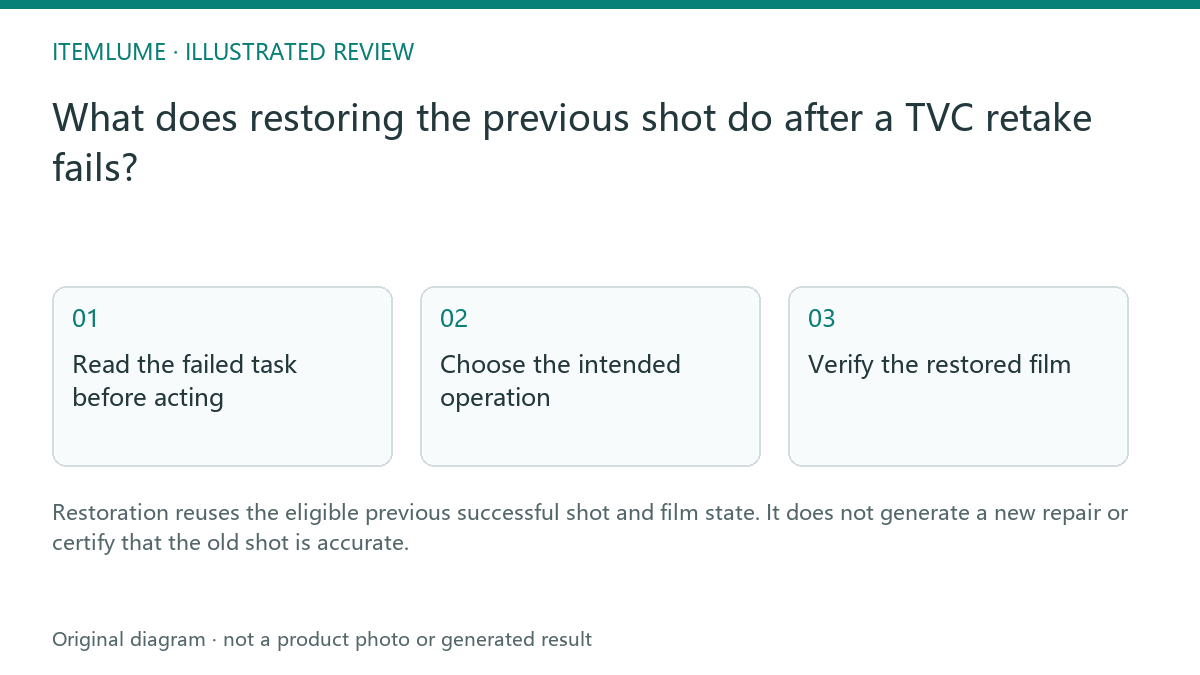
Read the failed task before acting
A fictional bottle film is complete. The seller approves a retake of shot five, but that retake reaches a confirmed failed state. The original successful shot and earlier assembled film still exist. Restoration can return that previous source to the sequence when the application verifies eligibility. A job that is merely slow, still active or uncertain is not the same case.
Keep the original task and request identity while checking status. Do not create a new job merely to discover whether the first retake finished. Record which shot was being replaced and which previous revision you intend to recover.
| Eligibility question | Required evidence | If absent |
|---|---|---|
| Is this the latest eligible retake failure? | Matching film, shot and request identity; confirmed failed retake | Keep investigating that request |
| Is any related work still active or uncertain? | No active or uncertain related retake; other source jobs succeeded | Do not treat it as a restorable failure |
| Can the old state actually be recovered? | Previous succeeded source and existing assembled output files | Follow unavailable-recovery guidance |
This is a reader checklist of the current service checks, not an instruction to edit task files. Other eligibility conditions may also block the operation; use the application response rather than force a state change.
Choose the intended operation
| Choice | What changes | Decision |
|---|---|---|
| Restore eligible previous shot | Reuses an existing successful source | Accept the earlier defect temporarily |
| New retake | Requests another generated source | Approve its current quote |
| New plan | Changes script or references | Review the complete new sequence |
The current restoration path restores the eligible previous successful source and existing film state. It does not request a new model generation or run a new assembly. Both the earlier source file and the prior assembled output must still be available; recovery does not recreate missing files. It is not a blanket refund rule for every failed job, and it does not make the earlier clip a successful repair. Review the task’s actual credit record separately.
Verify the restored film
After restoration, confirm the selected shot is the earlier successful source and that the displayed film revision matches the recovered state. Download the intended version and play through the affected cut. A browser tab showing an older film thumbnail is insufficient evidence of a completed restore operation.
For the fictional seller, annotate “earlier shot restored; cap distortion still rejected for publication.” This permits internal review without accidentally treating recovery as quality approval.
Record the failed request and the restored source identity beside the actual prior film file. Repeating an already recorded restore request returns the current view; it is not permission to roll a later film back again. Restoring the old state and submitting a new quoted retake are separate operations.
Handle unavailable recovery honestly
If the previous source file is unavailable, the application cannot safely promise restoration. Preserve the task evidence and follow the displayed recovery guidance. Do not upload an unrelated clip under the original shot number. If another retake is necessary, approve it as a new production decision and compare it against the same product reference.
Sources and further reading
Sources for this page were checked on . Platform rules can change; verify the current source before publishing. Prompt examples and workflow recommendations are CartVisual editorial guidance, not independently measured results.
Frequently asked questions
Does restoration call the video model again?
No. An eligible restore uses the previous successful source and existing film state. It does not run either new model generation or new film assembly.
Does it mean the old shot is now accurate?
No. Its earlier quality limitations remain.
Can an uncertain running retake be restored?
Do not treat an active or uncertain task as the confirmed failure case.
Can restoration rebuild a missing previous film?
No. The eligible previous source and assembled output must still exist. Follow the displayed recovery guidance if they are unavailable.
PREPARE ASSETS FOR YOUR NEXT STEP
Create supporting product assets in CartVisual.
Create new product creative assets in the workspace, then continue in your chosen tools. Third-party software procedures described in this guide take place in those applications; this workspace link does not imply an integration. Check current capabilities, account access and credit quotes.
Explore asset creation tools Check pricing and credits