 CartVisual
Assets & tasks / PRACTICAL ANSWER
Can I reuse my selected storyboard after changing the product brief?
A selected sheet belongs to its approved plan and references. Material brief changes need renewed planning and approval.
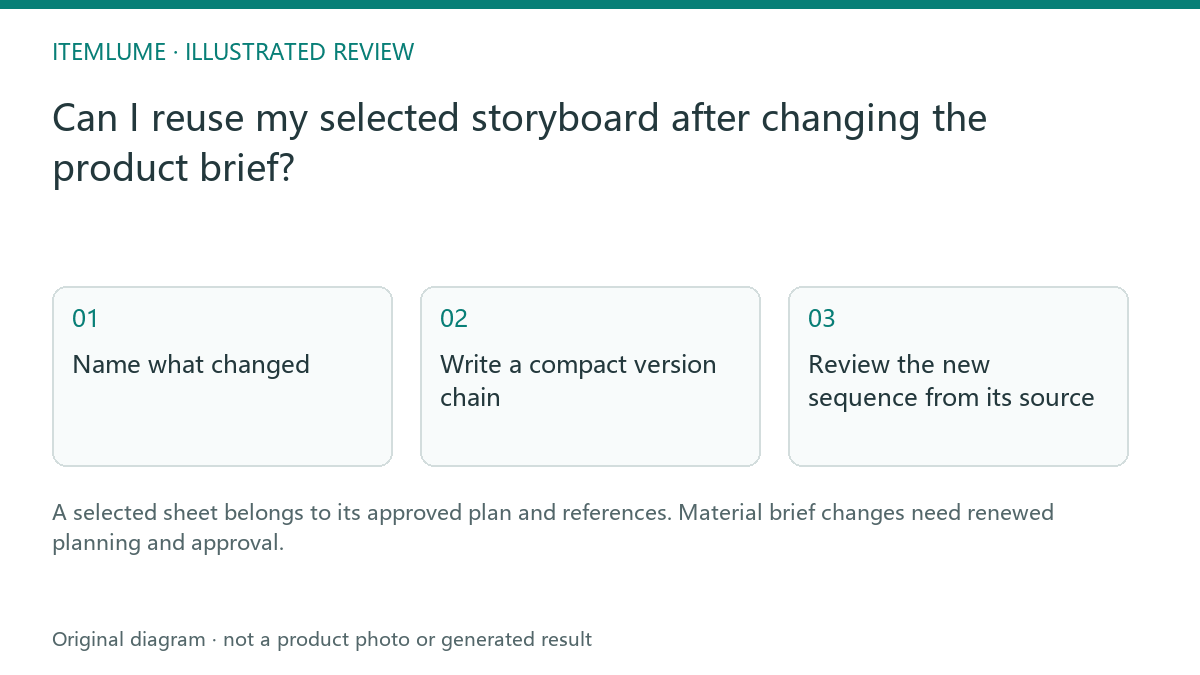
Name what changed
A fictional tumbler campaign initially advertises a 500 ml lid design. The seller later replaces the source with a 750 ml version and edits the key benefit. The old sheet can still be a useful visual reference, but it no longer approves the current merchandise. Reusing its plan without review would bind a new product to old scene descriptions and source frames.
Distinguish a purely editorial note from a change to product evidence, creative direction, aspect ratio, duration or bound model settings. The authenticated workflow checks these relationships. Do not label every surviving image as current merely because it remains visible in task history.
Write a compact version chain
| Version | Product reference | Approved status |
|---|---|---|
| Plan A | 500 ml source | Historical plan |
| Sheet A4 | Plan A | Historical selected option |
| Film A revision 2 | Sheet A4 | Previous completed film |
| Plan B | 750 ml source | Needs its own sheet and film approval |
This chain is an illustrative record, not a promise that the website imports arbitrary externally edited versions. Use the application’s actual task identifiers and keep descriptive names in your own handoff notes.
Keep machine identifiers and human descriptions separate. A plan/script ID, selected storyboard task and film revision establish application relationships; a note such as “750 ml SKU” records the seller’s approved scope. An application binding check is not automatic proof that a photographed bottle really holds 750 ml.
Review the new sequence from its source
Compare every new panel with the current tumbler. A changed capacity may alter shape, label and grip; it is not just one line of copy. If the same setting remains appropriate, preserve it as a creative direction while rebuilding the product-specific plan. Recheck duration and final product state before generating footage.
A completed earlier film should stay available as history. Its presence should not skip the new sheet-selection or frame-review stage. When in doubt, read the plan summary and source references rather than the most polished visible preview.
| What remains visible | What it means | Approval action |
|---|---|---|
| Saved historical plan and media | Evidence of that saved context | Keep its original product scope |
| Old preview beside changed current inputs | A retained image; current readiness may be stale | Read the stale notice and replan as required |
| New current plan and selected sheet | Candidate tied to its own references and settings | Review every extracted input and intended claim |
Current readiness uses plan identity and the current brief/reference/settings relationship. History can load a saved plan with its own saved context. Do not infer that either view transfers approval to a changed current brief. Follow the displayed state and inspect the actual reference, not only its filename.
Handoff without ambiguous approval
Write “Film A approved for historical 500 ml campaign only; Plan B not generated” until the new version passes review. This prevents an editor from publishing the old film for the new SKU. Technical recovery and retained media are useful, but neither establishes that an earlier approval extends to changed facts.
Before handoff, record the actual plan ID, selected sheet task, film revision, source reference identity and approved merchandise description. If any required relationship is unknown, mark it pending. Product evidence and generated presentation still need separate review even when the application accepts the version relationship.
Sources and further reading
Sources for this page were checked on . Platform rules can change; verify the current source before publishing. Prompt examples and workflow recommendations are CartVisual editorial guidance, not independently measured results.
Frequently asked questions
Can the old sheet inspire the new plan?
Yes, as a reference, with a separate approval for changed facts.
Does an old completed film mean the new plan is complete?
No. Read the version and source relationship.
Should I delete history to avoid confusion?
Keep history and label its approved scope clearly.
PREPARE ASSETS FOR YOUR NEXT STEP
Create supporting product assets in CartVisual.
Create new product creative assets in the workspace, then continue in your chosen tools. Third-party software procedures described in this guide take place in those applications; this workspace link does not imply an integration. Check current capabilities, account access and credit quotes.
Explore asset creation tools Check pricing and credits