 CartVisual
Product videos / PRACTICAL ANSWER
Which TVC shots should use real evidence instead of generated atmosphere?
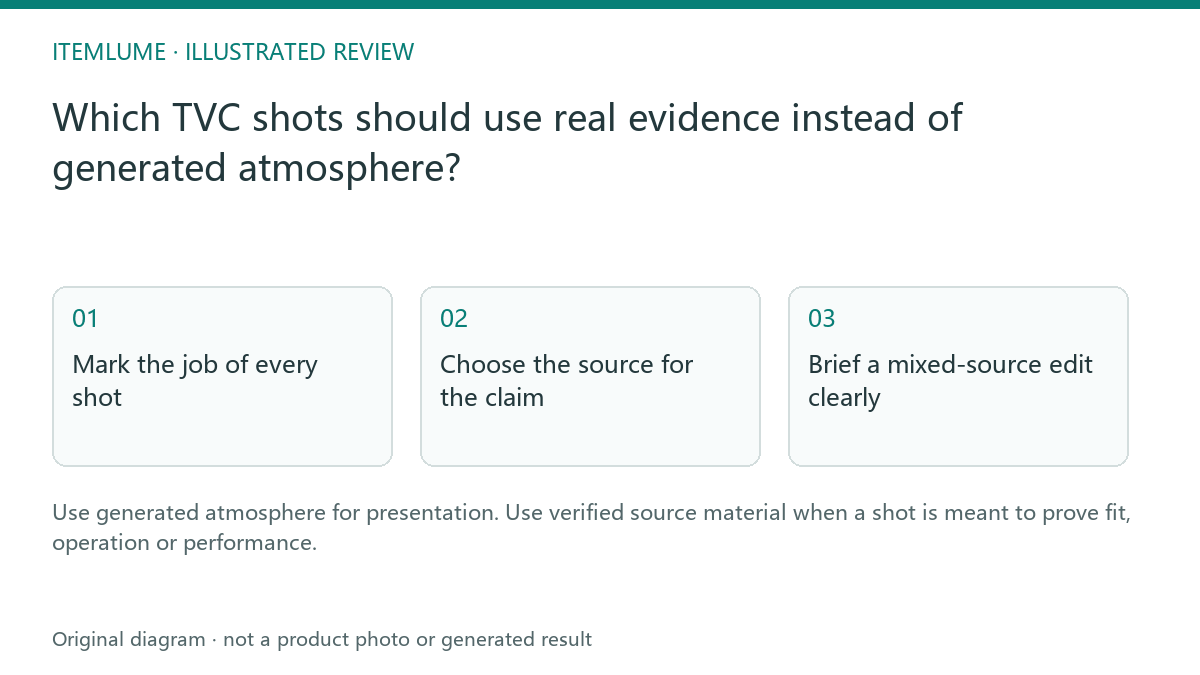
Use generated atmosphere for presentation. Use verified source material when a shot is meant to prove fit, operation or performance.
Mark the job of every shot
A fictional insulated flask campaign includes a tabletop reveal, lid detail, pouring action and a temperature-retention scene. The first two can present visible form. The last one implies measured thermal performance, which an attractive generated scene cannot establish. Mark each shot as presentation, visible-feature explanation or evidence-dependent demonstration before finalizing the script.
This classification helps direct production effort. It does not imply that generated presentation scenes are automatically accurate. Even a harmless tabletop view must preserve the lid, label and sold configuration.
A pouring scene can imply operation even without a measurement caption. Verify that the real flask opens, pours and seals in the way shown; do not dismiss invented mechanics as atmosphere. Count and classify every actual shot in the selected plan, whether it contains 9, 16 or 25 scenes.
Choose the source for the claim
| Planned scene | Role | Required basis |
|---|---|---|
| Light passes over bottle | Atmosphere | Accurate product reference |
| Close view of lid | Visible feature | Real lid photograph |
| Flask fits a narrow holder | Fit demonstration | Measured holder and real fit footage |
| Hot after a stated duration | Performance evidence | Relevant verified test; not a rendered glow |
The examples are editorial distinctions, not product test results. If a necessary evidence shot is unavailable, remove the claim, change the scene or capture the missing material. Do not let AI fill a factual gap with an invented demonstration.
| Claim record | Evidence scope | Allowed wording decision |
|---|---|---|
| “Fits this holder” | Measured named holder and genuine fit observation for this flask | Limit to the verified combination; not every cup holder |
| “Hot after a stated time” | Identified test conditions, method and result | Use only the supported duration and conditions |
| “Two visible parts” | Actual product photograph and included-items record | Describe visible/included parts without inventing performance |
These are hypothetical evidence requirements, not completed tests. Real footage of one fit does not establish universal compatibility, and a genuine measurement does not validate a different size or product revision. If the evidence scope is unknown, hold the claim rather than broaden it.
Brief a mixed-source edit clearly
Give an external editor the approved generated atmosphere and separately verified demonstration. Label which source supports each statement. Avoid cutting from a real test into a generated result in a way that suggests both are the same recorded event. Review transitions and captions for that implication.
Current CartVisual TVC generation creates its supported source clips; arbitrary real-footage insertion is an external editing decision. A planning table does not add an upload-and-splice feature to the website.
Keep each supplied demonstration’s filename, source, product revision and supported statement beside the generated atmosphere file. The current assembler uses its supported generated source sequence; this manual map does not create an arbitrary upload-and-splice control. Preserve both sources and require a fresh check of the external editor’s final file.
Review the full claim after editing
Watch the advertisement as a buyer and write down every performance or compatibility inference. Compare those inferences with the evidence record. Remove unsupported conclusions even when no single caption states them explicitly. The goal is a useful product story whose persuasive force comes from truthful features, rather than effects that resemble proof.
Use a comprehension review to learn what a viewer actually inferred, then compare that inference with the evidence scope. For audio and captions, give the finishing editor the same approved claim record. Clear storytelling does not substitute for support.
Sources and further reading
Sources for this page were checked on . Platform rules can change; verify the current source before publishing. Prompt examples and workflow recommendations are CartVisual editorial guidance, not independently measured results.
Frequently asked questions
Can a rendered glow prove heat retention?
No. Use appropriate verified evidence for a measured claim.
Can generated and real footage appear together?
Yes, with clear source roles and an external edit that does not misrepresent the evidence.
Does an atmosphere shot need accuracy review?
Yes. Product identity still matters.
PREPARE ASSETS FOR YOUR NEXT STEP
Create supporting product assets in CartVisual.
Create new product creative assets in the workspace, then continue in your chosen tools. Third-party software procedures described in this guide take place in those applications; this workspace link does not imply an integration. Check current capabilities, account access and credit quotes.
Explore asset creation tools Check pricing and credits